
Cosmetics PIF (Product Information File) Obligations and Recall Risk in Vietnam: Practical Response Points Drawn from Recent Cases
Under Vietnam's cosmetics regulations, companies are strictly required to prepare, maintain, and be able to present a PIF (Product Information File). Based on recent administrative sanctions and product recall cases, this article explains the legal risks of failing to maintain a PIF, how to respond to recall orders, and key points for building a distribution management system. NEXORA LAW FIRM provides practical, on-the-ground support to Japanese and other companies regarding cosmetics compliance, regulatory response, and recall practice.
01 - Increased Scrutiny of the PIF (Product Information File) in the Cosmetics Sector in Recent Years
In recent years, Vietnam's Ministry of Health has strengthened post-market surveillance (post-inspection) of cosmetics manufacturing and distribution, with a central focus on the state of preparation and maintenance of the Product Information File (PIF), which is mandated under cosmetics management regulations.
On November 5, 2025, the Drug Administration of Vietnam issued Administrative Sanction Decision No. 654/QĐ-XPHC against Japan Connection Investment & Trading Co., Ltd. ("Japan Connection"), covering:
The sale of cosmetic products for which a PIF was not maintained or could not be presented
An order to recall and destroy the non-compliant products
Of particular note is that many of the recalled products were brands very familiar to Vietnamese consumers (for example, Hatomugi, Pantene, and Bigen Cream, all notified under the name of Japan Connection).
According to materials published by the Drug Administration of Vietnam, the nine cosmetic products ordered to be recalled and destroyed are as follows.
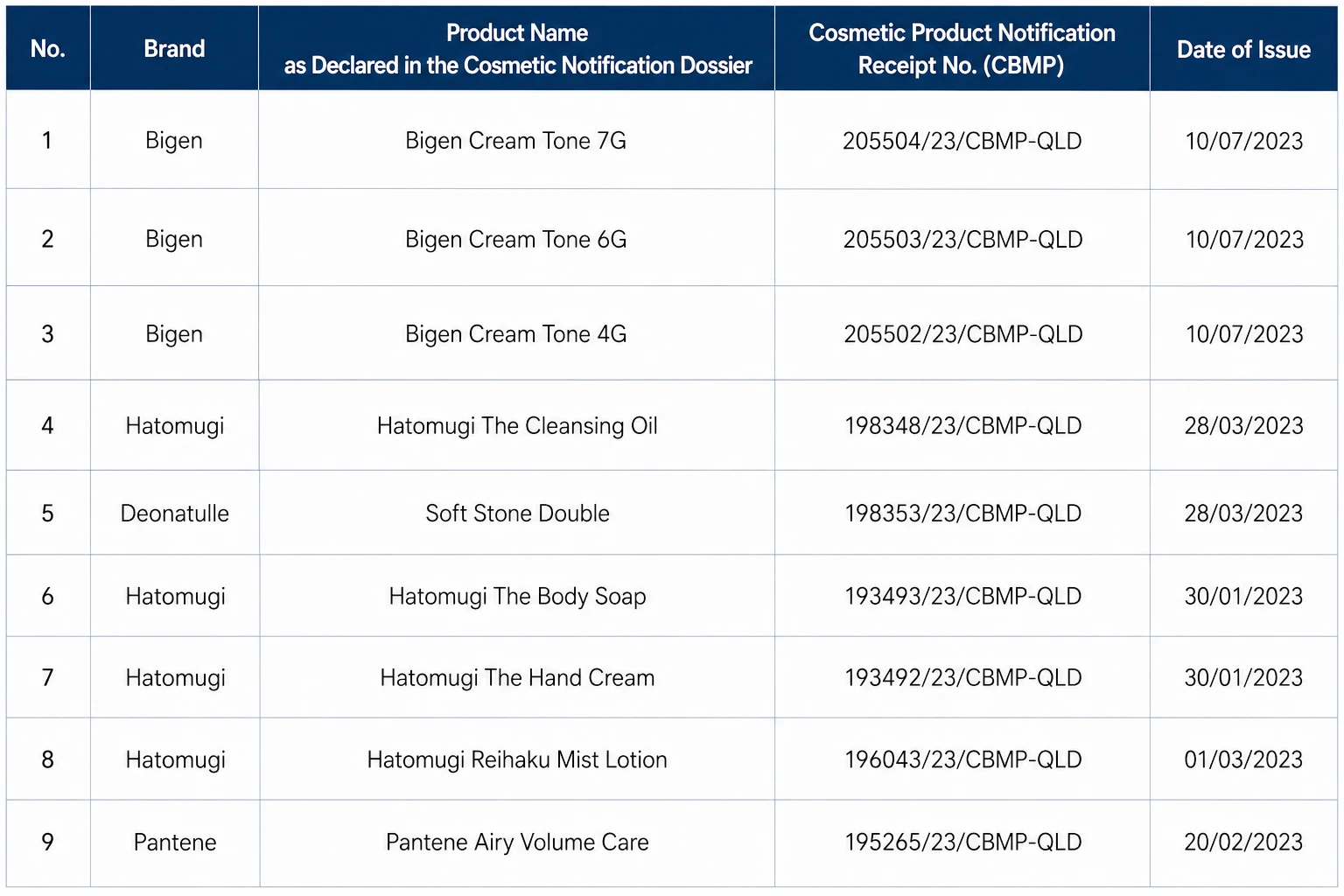
As of December 3, Japan Connection submitted a report on the status of its compliance with the sanction decision. According to the company, since the decision was published on the Drug Administration of Vietnam (DAV) portal, there have been no customer complaints or product returns, and it therefore stated that "no products remain to be recalled or destroyed."
In response, in order to ensure that handling is carried out properly and thoroughly, the Drug Administration of Vietnam notified the Departments of Health of provinces and centrally run cities of the following: that businesses selling or using cosmetics within their jurisdiction must immediately halt distribution of the nine products above, and that if inventory remains, it must be returned to Japan Connection. Each Department of Health bears responsibility for inspecting and supervising the businesses' recall implementation, and for taking strict action in accordance with the law where continued sale is found.
At the same time, the Drug Administration of Vietnam instructed Japan Connection to issue a recall notice across its entire distribution network, and to carry out the receipt, recall, and destruction of returned products in accordance with proper procedures. The company bears full responsibility for this entire process and must submit a further report, together with supporting evidence, to the Drug Administration of Vietnam by January 5, 2026.
In addition, the Hanoi Department of Health has been instructed to continuously follow up on, supervise, and confirm Japan Connection's implementation of the recall and destruction, and to report the results to the Drug Administration of Vietnam by January 10, 2026.
02 - Cosmetics PIF Obligations and Recall Risk: Practical Points Companies Should Review Immediately
From the above case, the following important points can be drawn for companies conducting cosmetics business in Vietnam.
The PIF (Product Information File) is a legal obligation of the company, and responsibility for it rests squarely with the product notifier.
Companies must not only prepare and maintain a PIF, but must also have a system in place to present it promptly and completely when inspected or audited by the competent authorities. This applies regardless of whether the cosmetic product has already been assigned a notification receipt number.
The absence of remaining inventory does not mean the recall and destruction obligation has ended. Where products remain in the market through a network of sales agents, retailers, distributors, etc., ultimate responsibility for the recall rests with the notifying company, and this remains subject to oversight by the regulatory authorities.
Companies should build and operate an effective distribution chain management system, including contract management, distribution management, lot tracing, and recall procedures. This enables a prompt and appropriate response even when corrective measures are demanded by the authorities.
Raising compliance awareness is also essential for distributors and retailers. They must continually verify the legal status of the products they handle, and take steps to prevent the risk of joint liability arising from the continued sale of recalled products.
Overall, as post-market regulatory enforcement by the authorities intensifies, reviewing legal documentation, building a compliance framework, and enhancing risk management are essential—not merely to avoid sanctions, but to operate the business in a stable, transparent, and sustainable manner.